
FrontierScholar: Bringing the Frontiers of Science to Your AI Agent
Finding relevant papers is only the beginning. Understanding how a field has evolved, what matters today, and what remains open takes much more work. For an AI agent it is harder still: web search returns scattered links and abstracts, and a paper PDF costs tens of thousands of tokens with no structure to navigate, so an agent can rarely see the whole of a field within its token budget.
FrontierScholar is a research knowledge base built for AI agents. It organises the literature into a structured map of research: domains, topics and subtopics; for every subtopic, pages on its research problems, method families, datasets and benchmarks, plus a frontier page on rising approaches and open problems. Every claim on these pages points back to the papers it comes from. Agents explore the map through one command-line tool, fs.
The first release covers about 1.01 million computer-science papers. It is free to use, with no registration required.
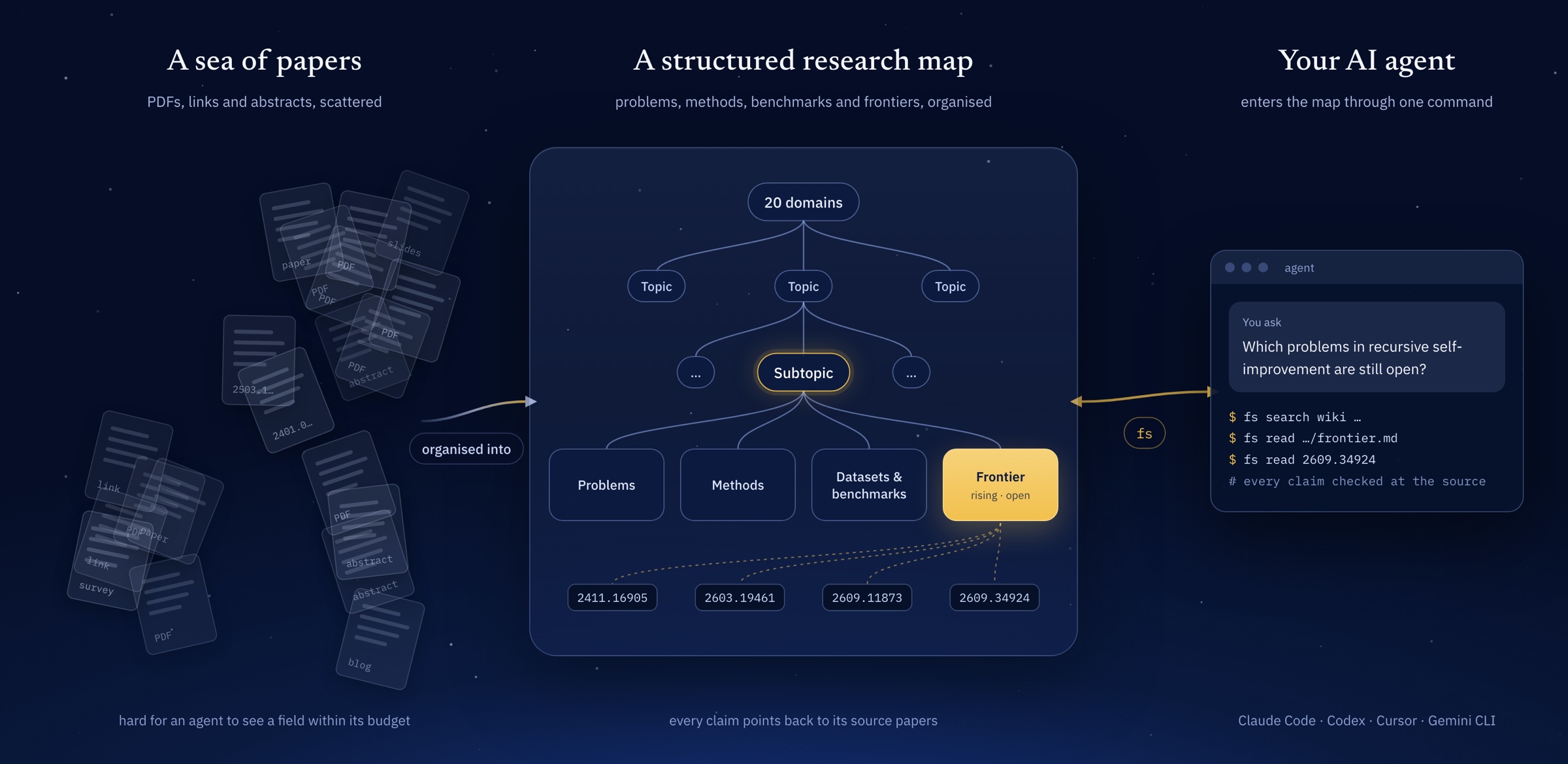
A Research Landscape Your Agent Can Explore
- Organised by research area: each subtopic brings together its key problems, methods, benchmarks and emerging directions, linked to one another.
- Helps agents see progress: follow how an area develops, compare approaches and find open questions, with every statement backed by papers that can be checked against the original.
- Reliable dates: every paper carries its first public release date, so an agent can restrict itself to work before a given cut-off.
Here are two examples.
Recursive self-improvement. Ask your agent: "Where does recursive self-improvement stand today, and which problems are still open?" It works its way across the map:
- Find the area:
fs search wiki --level subtopic "self-improvement"lands on Artificial Intelligence → AGI Theory and Machine Consciousness → Recursive Self-Improvement. - See the whole area:
fs read …/recursive-self-improvementshows 123 papers and the area's pages on problems, methods, resources and its frontier. - Read the frontier:
fs read …/recursive-self-improvement/frontier.mdlists the rising approaches and the open problems, when each was first raised and how many papers support it. Rising: model–harness co-evolution. Open since March 2026: how to tell genuine self-improvement from the apparent kind. - Check the source:
fs read 2609.34924opens a September 2026 paper the frontier cites [8], so the agent can check the claim in the authors' own words: "Rewriting scaffolding (tools, verifiers, decomposition) expands what an agent reaches without touching a weight".
AI scientists. Ask: "For end-to-end AI scientist systems, what are the leading approaches, and what is still unsolved?"
The agent lands on Artificial Intelligence → AI for Scientific Discovery → End-to-End AI Scientist Systems (360 papers). On the frontier page, self-evolving research harnesses and evidence-governed claim admission are rising; among the open gaps, "verification is not independent of generation" is backed by 9 papers, the latest from 8 October 2026. Opening that paper with fs read 2610.11253 [9] shows the authors' own words: "explanation rubric rewards a distinction no legal experiment can make".
Four commands take you from a question to the evidence. Frontier pages are our synthesis of the papers, while abstracts are the authors' own words; the two are labelled separately, so an agent can say exactly what its answer rests on.
Results Across Three Research Scenarios
We evaluated FrontierScholar in three scenarios on four public benchmarks:
- Paper search: find relevant work and see where it fits in the wider landscape (AutoResearchBench Wide Research [1], RealScholarQuery [2]).
- Report generation: write structured, evidence-backed reports on a topic's progress, leading approaches and open challenges (ScholarQABench [3]).
- Idea proposal: propose research informed by existing work, emerging trends and open gaps (IdeaScientist [4]).
We compare two setups of the same coding agent: with FrontierScholar (Agent + FrontierScholar), and with web search and page fetching only (Agent + Web Search & Fetch). We also compare against Google AI Studio (Gemini with Google Search) [7], alphaXiv [6] and Asta [5].
| Setup | AutoResearchBench | RealScholarQuery | ScholarQABench | IdeaScientist |
|---|---|---|---|---|
| Agent + FrontierScholar | 0.466 | 0.596 | 71.1 / 52.4 | 73.3 |
| Agent + Web Search & Fetch | 0.369 | 0.492 | 70.6 / 48.2 | 72.3 |
| Google AI Studio (Gemini, Google Search) | 0.169 | 0.415 | 67.9 / 25.8 | 66.1 |
| alphaXiv | 0.240 | 0.413 | 65.8 / 41.7 | 72.5 |
| Asta | — | 0.215 | 67.0 / 44.6 * | 47.0 |
Evaluation notes: paper search reports recall (0–1); ScholarQABench reports rubric score / citation recall (0–100, LLM-judged); IdeaScientist reports the mean of novelty and quality (0–100). Both agent setups use the same coding agent and model and differ only in their tools; the other products are their live versions in October 2026. On IdeaScientist, samples in which an agent retrieved the target paper are masked. * Asta completed 37 of 100 ScholarQABench questions and has no AutoResearchBench result.
The clearest gain is in paper search: recall is 21–26% higher than Agent + Web Search & Fetch, and more than 40% higher than the other products. In report generation and idea proposal, Agent + FrontierScholar also scores higher than every other setup on rubric score, citation recall and overall score.
Starting with Computer Science, Expanding Across Science
The first release covers computer science. Next we will add more disciplines and more kinds of literature, with the long-term goal of a connected map of the scientific literature across disciplines.
Try It with Your Own Agent
The first release is free and needs neither registration nor an API key. Registration will open later for users who need higher limits.
pip install frontier-scholar                    # the fs command-line tool (Python 3.8+, no dependencies)
fs search paper "AI scientist" --topk 5          # works right away, no key needed

npx skills add FrontierScholar/FrontierScholar  # give your coding agent the skill
You can also download the skill directly with curl -fsSLO https://frontier-scholar.com/downloads/fs-cli.zip and unzip it into your agent's skills folder.
With the skill installed, just ask in plain language, for example: "Use fs: what are the open problems in recursive self-improvement, and which approaches are rising?" It works with agents that support skills, such as Claude Code, Codex, Cursor and Gemini CLI.
Without a key, each IP gets 30 requests a minute and 300 a day. Commands and options are in the documentation. Tell us which fields you would like covered and how you use it in your research.
References
- AutoResearchBench: Benchmarking AI Agents on Complex Scientific Literature Discovery. arXiv:2604.25256, 2026.
- PaSa: An LLM Agent for Comprehensive Academic Paper Search (introduces RealScholarQuery). arXiv:2501.10120, 2025.
- OpenScholar: Synthesizing Scientific Literature with Retrieval-augmented LMs (introduces ScholarQABench). arXiv:2411.14199, 2024.
- IdeaScientist: Orchestrating Agents for Grounded Scientific Ideation. arXiv:2610.04074, 2026.
- Asta, Allen Institute for AI. asta.allen.ai; AstaBench: Rigorous Benchmarking of AI Agents with a Scientific Research Suite. arXiv:2510.21652, 2025.
- alphaXiv. alphaxiv.org
- Google AI Studio. aistudio.google.com
- Audit the Scaffold, Not the Checkpoint: A Stationarity Dichotomy for Recursive Self-Improvement in Agentic Coding. arXiv:2609.34924, 2026.
- LLM-IDEA: Identifiability-Driven Experimental Agent for Autonomous Discovery of Mechanistic World Models. arXiv:2610.11253, 2026.